Learn Fast & Speak Fluently
- 3.8
- Rating
- 5.00M
- Installs
- Free
- Price
 Analysis by App-foxy
I approached Learn Fast & Speak Fluently as a practical language-learning app rather than a replacement for a teacher or a full course. Its main appeal is the way it turns study into short, interactive sessions that are easier to fit around ordinary life. After using it, I found the experience most useful when I treated it as a daily practice tool: open it with a clear goal, complete a focused lesson, and return later for another small block instead of expecting one long session to create fluency.
The app comes from Aykonu and sits in the education category. It is free to install, rated for Everyone, and works on devices running Android 7.0 or later. Its current version is 3.3.4, and its audience is already substantial, with more than five million installs and an average rating of 3.9 from roughly eleven thousand ratings. Those figures suggest a widely tried app, but they also tell me to keep expectations sensible: this is a convenient learning companion, not an automatic shortcut to confident conversation.
How I built a useful baseline routine
My first recommendation is to avoid opening the app without deciding what “a good session” means. If I have only a few minutes, I focus on finishing one lesson carefully rather than tapping through several activities while distracted. If I have more time, I use the first lesson as a warm-up and then return to difficult material while it is still fresh. That simple distinction makes the app feel much more purposeful.
You May Also Like

 Blood Strike: 2.5 Anniversary
Blood Strike’s Loadouts Turn Every Drop Into a Tactical Gamble
A close look at Blood Strike’s custom loadouts: how fast access to signature weapons reshapes its battle royale rhythm, rewards preparation, and narrows the gap between fights.

 Pandora - Music & Podcasts
Pandora’s Music Is Easy to Start, but Harder to Recover
Pandora’s strength is its low-effort path from a seed to a station. Its weak spot is how much confidence it asks you to place in connection, setup, and quiet recovery.

 8 Ball Pool
 Is Built on Rivalries, Rematches, and Routine
A close look at the rivalries, rematches, shared routines, and unanswered safety questions that turn a quick pool match into a persistent mobile community.

 Samsung Music
’s Quiet Strength Is Playing What You Already Own
Its reach comes less from spectacle than from dependable access to a personal library. That simplicity is both the app’s strongest retention engine and its ceiling.

 AccuWeather: Weather Radar
AccuWeather Review: A Quick, Clear Forecast for Everyday Decisions
For everyday plans, the best forecast is the one you can understand quickly. AccuWeather makes rain timing, radar, and local conditions easy to act on, with a few trade-offs.

 Hill Climb Racing
Why Hill Climb Racing Still Turns Crashes Into One More Run
A tiny car, a bumpy hill and one more upgrade: Hill Climb Racing keeps resurfacing because its simple chaos makes every near-miss feel personal.
More From Our News Desk



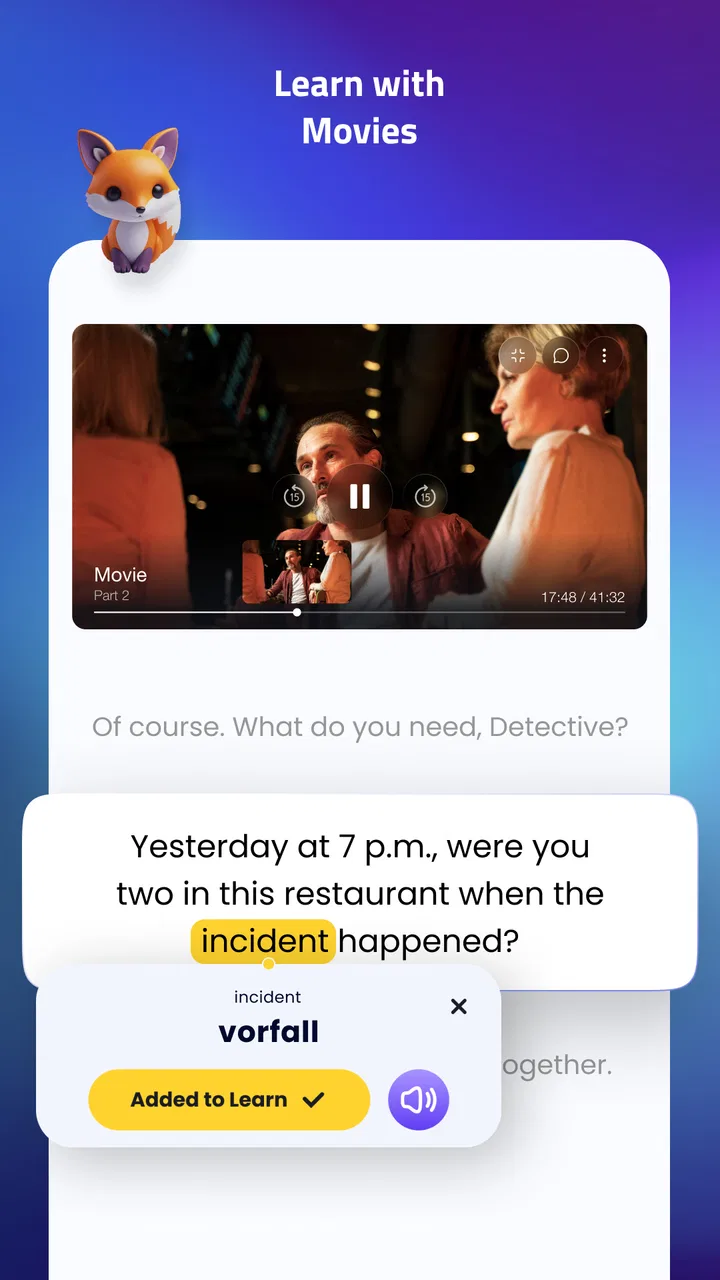
The personalized, interactive format works best for learners who need structure. Instead of staring at a word list and deciding what to do next, I can follow the sequence presented by the app and let the lesson provide the momentum. This is particularly helpful for beginners who feel overwhelmed by grammar books, large vocabulary decks, or open-ended video courses. The guided format reduces the number of decisions I have to make before studying.
I would not use it as my only language contact. A lesson can help me recognize and practice material, but real communication also involves hesitation, incomplete sentences, different accents, and unexpected replies. I get better results when I pair the app with a small real-world task, such as writing a short message, reading a menu, or saying several newly learned phrases aloud without looking at the screen.
A realistic everyday session
Imagine that I am learning during a commute or just before dinner. I begin with one lesson and keep my attention on the prompts instead of rushing for completion. When an answer feels uncertain, I pause mentally and identify the problem: did I forget the word, misunderstand the sentence, or choose the wrong form? That distinction matters because each mistake needs a different response. Vocabulary gaps call for repetition, while sentence-pattern problems require slower reading and more deliberate practice.
After the lesson, I spend a minute recalling the key expressions without immediately reopening the answers. This is one of the most useful habits I found. The app supplies the exercise, but the extra recall step tests whether the material stayed with me. I then make a note of one phrase I could actually use that day. The goal is not to collect the largest possible number of new items; it is to move a small number from recognition toward active use.
For a busy learner, this approach is more realistic than promising an uninterrupted study hour. The free access also makes it easy to test whether the lesson style suits you before spending money. In-app purchases range from $4.99 to $29.99 per item, so I would first establish a routine with the free experience and only consider a purchase after identifying a specific benefit I would use regularly.
Who gets the most from the lesson design
I think the strongest audience is the learner who starts enthusiastically but loses direction after a few days. The interactive structure gives that person a clear next action. It can also suit someone returning to a language after a long break, because short guided activities feel less intimidating than rebuilding a complete study plan from scratch.
It is less convincing for an advanced learner who already knows how to organize grammar review, reading practice, listening input, and conversation. At that stage, a specialized resource may provide deeper explanations or more challenging material. I would also hesitate to recommend relying on this app alone if your immediate goal is professional speaking, exam preparation, or detailed writing accuracy. Those goals normally need feedback and content tailored to the exact situation.
Settings and study choices worth checking
The most important “settings” are the choices I make before and during a session. I pay attention to the lesson level, the pace at which I move through prompts, and whether I am answering from memory or simply recognizing a familiar screen. Personalization is valuable only when I give the app honest signals. Guessing quickly may feel efficient, but it can leave me with a misleading sense of progress.
I recommend choosing a level that is slightly comfortable rather than immediately selecting the hardest available material. If every prompt becomes a guessing exercise, the lesson loses its teaching value. On the other hand, if every answer is effortless, I am probably practicing recognition instead of extending my ability. The productive middle ground is material I can usually follow but must still think about.
Another useful adjustment is changing the way I interact with the lesson depending on my surroundings. In a quiet room, I can slow down and repeat phrases aloud. In public, I may focus on reading and recall, then revisit the same material later for speaking practice. This prevents a common mistake: judging the app as weak simply because I used it in a setting where I could not engage fully.
How to make personalization work harder
I treat personalization as guidance, not as a substitute for self-assessment. If a topic keeps causing errors, I do not immediately blame the lesson. I ask whether I am confusing similar words, skipping the examples, or studying when too tired to remember anything. A short, attentive session often teaches me more than a longer session completed mechanically.
I also avoid changing direction too often. Jumping between unrelated topics can feel varied, but it makes it harder to notice patterns. I prefer staying with a theme long enough to encounter its vocabulary in several forms. Then I test myself later by trying to explain the topic in simple language. This creates a bridge between the app’s prompts and spontaneous use.
Notifications and reminders, when available in the version on your device, should be treated as prompts rather than obligations. A reminder can protect a routine, but it cannot decide whether today’s session should be new material or review. I would rather study less and remember more than maintain a streak by tapping through content with no attention.
What the free and paid paths mean in practice
The free starting point is a genuine advantage for cautious users. I can learn whether the pacing, exercise style, and level of personalization fit my habits before making a purchase. That matters because language apps are highly personal: one learner enjoys compact interactive prompts, while another needs long explanations, audio-heavy practice, or direct conversation.
Paid items may make sense for someone who has already formed a repeatable routine and wants to extend the experience. I would not buy simply because I felt guilty about an inconsistent week. A purchase cannot solve a scheduling problem. I would also read the purchase screen carefully and decide whether the additional material matches my target language and current level before committing.
The app’s Everyone rating makes it approachable for a broad audience, but age suitability does not guarantee that every learner will find the content sufficiently deep. Parents or younger learners may appreciate the accessible format, while adults studying for a specialized purpose may need to supplement it with material that uses workplace, academic, or travel-specific language.
Faster patterns that improve retention
The fastest approach I found was not tapping faster. It was reducing wasted effort between sessions. I keep a small list of phrases that repeatedly cause trouble, then use the app to revisit the underlying lesson instead of endlessly memorizing isolated translations. When a phrase remains difficult, I create a personal example connected to something I might genuinely say. A phrase about ordering food, describing a schedule, or asking for help becomes easier to remember when it has a clear use.
I also separate recognition from production. During an app exercise, I may recognize the correct answer because I have seen it before. To check whether I can actually use it, I cover the choices and say the answer aloud first. If I cannot produce it, I count that as partial knowledge rather than mastery. This small change prevents the interface from making my progress look better than it is.
A repeatable three-pass method
My preferred pattern has three passes. On the first pass, I complete the activity normally and focus on understanding the sentence. On the second, I revisit the items that felt uncertain and explain to myself why the correct response works. On the third, I leave the screen and try to recall the useful phrases in a different context. The app handles the structured practice, while the final pass adds the active recall that many learners skip.
This method is especially helpful when I have only a short window. I do not need to repeat an entire course immediately. Instead, I select the parts that exposed a weakness and use them as a compact review target. The trade-off is that this requires more discipline than simply following the next lesson, but it gives the personalization a clearer purpose.
Another efficient habit is to stop while I still have some attention left. It is tempting to continue because the activities are easy to start, but tired repetition can reinforce careless answers. I would rather end after a focused lesson and return later than turn the app into background noise. Consistency comes from making sessions sustainable, not from forcing maximum volume every day.
Where it compares well with familiar alternatives
Compared with a traditional textbook, the app is more immediate and less demanding to organize. I can begin a guided activity without deciding which chapter to open or which exercise to assign myself. The textbook still wins when I need a detailed explanation, a complete reference, or a clear overview of grammar progression.
Compared with flashcards, the interactive lessons can provide more context than a single word-and-definition pair. Flashcards remain better for highly targeted review, especially when I already know exactly which vocabulary needs attention. The two approaches work well together: the app introduces or practices material in a guided setting, while a separate personal list can keep troublesome phrases visible between sessions.
Compared with conversation tutoring, this app is cheaper to try and easier to use at any moment, but it cannot reproduce the pressure of a real exchange or correct every personal speaking habit. A tutor is the better choice when pronunciation feedback, spontaneous dialogue, or professional accuracy is the priority. Learn Fast & Speak Fluently is strongest in the space before that conversation: building enough familiarity and confidence to make practice less intimidating.
Advanced limits and the points where I would look elsewhere
The central limitation is the gap between completing interactive exercises and speaking freely. Even a well-designed lesson can let me remain a responder instead of an initiator. I have to create opportunities to form my own sentences, ask my own questions, and recover when I forget a word. Without that extra work, progress may remain tied to the app’s familiar prompts.
I also would not assume that a personalized sequence automatically matches my exact objective. A person preparing for a trip, a student preparing for an assessment, and a professional preparing for meetings may all need different vocabulary and levels of formality. If the app’s material does not align with the situations I face, I would use it for foundational practice while adding targeted resources rather than forcing it to serve every purpose.
The 3.9 average rating reflects a generally positive but not universal experience. I read that as a reason to try the app personally instead of treating its popularity as proof that it will suit everyone. Learning style, target language, available time, and tolerance for guided repetition all affect the result. The fact that it has around eleven thousand ratings and more than five million installs shows reach, not a guarantee of individual success.
When another option is the better choice
I would choose a textbook or reference course first if I wanted systematic grammar explanations and the ability to study a rule in depth. I would choose flashcards first if my main problem were retaining a carefully selected vocabulary list. I would choose a tutor or conversation group if I needed immediate speaking confidence, detailed corrections, or accountability from another person.
I would also skip making this my main tool if I dislike short interactive exercises or prefer learning through long-form reading and listening. The app’s convenience is a strength only when its format keeps me engaged. If I repeatedly rush through the prompts, I am paying with attention rather than gaining useful practice.
For families, the Everyone rating makes the app broadly accessible, but I would still help a younger learner set a realistic routine and check whether the activities are being understood rather than merely completed. For independent adult learners, the better question is not whether it promises fast fluency, but whether its lessons make you return often enough to build a foundation.
My verdict after turning it into a habit
I see this as a solid entry point for people who want guided language practice without immediately paying for a course. Its greatest strength is practical: it lowers the effort required to begin studying and gives a learner an interactive path to follow. Aykonu has positioned it as a free education app, and that makes experimentation easy, even though optional purchases between $4.99 and $29.99 per item should be considered carefully.
The best results come from combining the app with deliberate habits: slow down when an answer is uncertain, say important phrases aloud, revisit recurring mistakes, and test recall away from the screen. Those steps turn a sequence of prompts into actual learning. They also reveal the app’s proper role. It can organize practice and build familiarity, but I still need reading, listening, writing, and real conversation to become genuinely fluent.
With its May 10, 2024 release and current version 3.3.4, it is a relatively recent option that has already reached a large audience. I would recommend trying the free experience to beginners, returning learners, and busy people who need a manageable routine. I would be more cautious for advanced students or anyone with a narrow exam or professional target.
My final opinion is straightforward: use it as the dependable daily middle layer between intention and real language use. It is more structured than studying from random videos, more contextual than isolated word memorization, and more convenient than arranging a lesson. Just do not mistake convenience for completeness. If you use its guided practice as a base, then add your own recall and real-world speaking, it can earn a regular place in a serious learning routine.
FAQs for Learn Fast & Speak Fluently
01What is Learn Fast & Speak Fluently?
Learn Fast & Speak Fluently is a mobile application designed to help users improve their language skills quickly and effectively. It offers various levels and lessons tailored to different languages and proficiency levels, making it ideal for beginners and advanced learners alike.
02Is Learn Fast & Speak Fluently suitable for beginners?
Yes, the app is suitable for beginners as it offers a range of introductory lessons that start from the basics. The interactive exercises and user-friendly interface make it easy for new learners to grasp fundamental concepts and vocabulary.
03Does the app support multiple languages?
Learn Fast & Speak Fluently supports a wide range of languages, including popular options like Spanish, French, Mandarin, and German. This diversity allows users to choose and switch between languages, catering to both personal and professional learning goals.
04Are there any in-app purchases or subscriptions?
While the app offers a free version with basic features, there are in-app purchases and subscription options available for users who want access to advanced lessons and additional resources. These premium features are designed to enhance the learning experience with more comprehensive content.
05Can I use Learn Fast & Speak Fluently offline?
Yes, the app offers offline capabilities, allowing users to download lessons and practice without an internet connection. This feature is particularly beneficial for users who wish to learn on the go or in areas with limited connectivity.
Pros
- User-friendly interface for easy navigation.
- Wide variety of languages available to learn.
- Interactive lessons keep users engaged.
- Offline mode for learning on the go.
- Progress tracking with detailed analytics.
Cons
- Limited free content
- requires subscription.
- Occasional bugs in voice recognition.
- Some lessons feel too basic for advanced users.
- Ads can be intrusive in free version.
- Requires internet for certain features.

Learn Fast & Speak Fluently
Gallery